
PTFE vs Silicone Coated Fabrics: Which Is Right for Your Application?
PTFE‑coated fabrics and silicone‑based materials often show up in the same factories, but they solve very different problems. Choosing between them correctly is critical for reliable heat sealing, conveying, gasketing, and insulation in New Zealand manufacturing plants.
PTFE‑Coated Fabrics – High‑Temperature, Non‑Stick Release
What is a PTFE‑coated fabric?
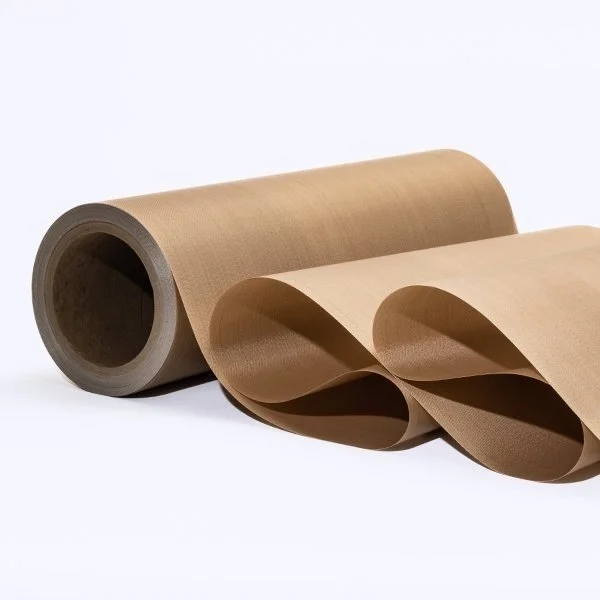
PTFE‑coated fabrics start with a high‑strength woven substrate (typically fiberglass) that is impregnated or coated with PTFE (polytetrafluoroethylene). The result is a dimensionally stable material with a very low friction, non‑stick surface on one or both sides.
Typical characteristics of quality PTFE fabrics include:
Continuous operating temperatures up to around 260°C (500°F).
Excellent release and low surface energy, so molten plastics, rubber and adhesives do not readily stick.
High mechanical strength from the fiberglass, with low stretch and good flex fatigue.
Chemical resistance to most acids, bases and solvents.
Good dielectric strength for electrical insulation and RF processes.
BIL supplies PTFE‑coated fabrics from Saint‑Gobain Versiv, Taconic and others, in standard, premium, porous, anti‑static and open mesh grades.
Where PTFE fabrics are used
Because of their non‑stick surface and heat resistance, PTFE‑coated fabrics are typically used where product must release cleanly from a hot surface.
Common applications include:
Heat sealing and packaging
Release sheets and covers on tray sealers, blister seal tools, and jaw faces.
PTFE belts and webs in form‑fill‑seal or flow‑wrap discharge and transfer sections.
Food processing and baking
Non‑stick conveyor belts for bakery plants and snack lines.
Baking liners and release sheets for sticky doughs and sugar‑rich products.
Plastics and rubber processing
Release liners for extruded profiles, rubber curing, and foam expansion.
PTFE belts for cooling, drying, and curing ovens.
Composites and industrial laminating
Release sheets for composite layup, vacuum pressing and laminating.
Skid‑resistant or anti‑static finishes where static control is needed.

Silicone‑Based Materials – Sealing, Cushioning and Insulation
What do we mean by “silicone coated fabrics” here?
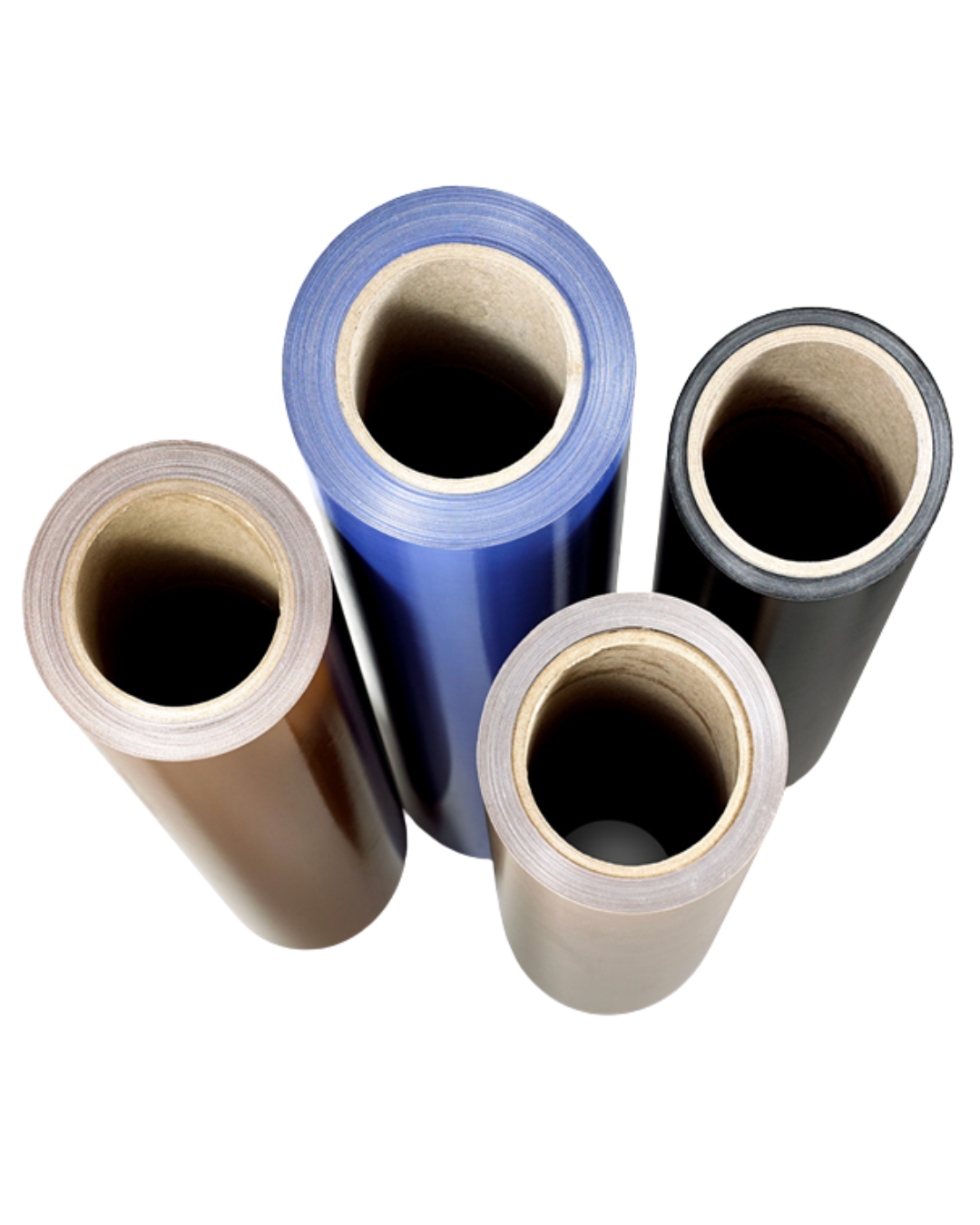
“Silicone coated fabrics” usually means silicone rubber bonded to a reinforcement (often fiberglass), or silicone sponge/foam supplied as tape or sheet. BIL also supplies solid and sponge silicone rubber sheets that customers often use alongside PTFE fabrics for sealing and insulation.
Key forms include:
Silicone sponge sheets for compressible gaskets.
Silicone solid sheets in Shore A 30–70 for dense gaskets and pads.
Silicone foams for lightweight, flame‑retardant sealing and insulation.
Silicone SNS tapes that convert silicone sponge/foam into pressure‑sensitive tape form.
Silicone material properties
Silicone rubber has a unique chemical structure that gives it excellent thermal stability and weathering resistance.
Typical features include:
Temperature capability from around ‑100°F to 500°F (approximately ‑73°C to +260°C), depending on grade.
Outstanding resistance to UV, ozone, moisture and fungus, making it suitable for outdoor gaskets.
Good compression set resistance, so gaskets recover after compression.
Availability in different durometers, densities and constructions: soft foam to firm sponge to solid rubber.
Many grades with UL 94 and FAR 25 flame classifications, especially in the F‑12/F‑20 foam family.
Where silicone is used
Silicone‑based materials are chosen when you need a sealing, cushioning or insulating function, rather than a hard non‑stick sliding surface.
Typical use cases include:
Environmental and door gaskets
Access panel seals on enclosures and OEM machinery.
Outdoor lighting gaskets and EV/battery housing seals.
Railcar, marine and mass transit gasketing where low smoke and flame performance are required.
Thermal and acoustic insulation
Pads and barriers around ovens, dryers and heaters.
Press pads and thermal barriers in PCB or laminate pressing.
Vibration and noise damping
Silicone sponge and foam tapes as vibration‑damping strips.
Equipment feet, cushions and spacers.
High‑temperature, compressible seals around heat sealing and packaging equipment
Backing pads and insulation behind heat seal jaws.
Gaskets in hot air tunnels, shrink ovens and drying systems.

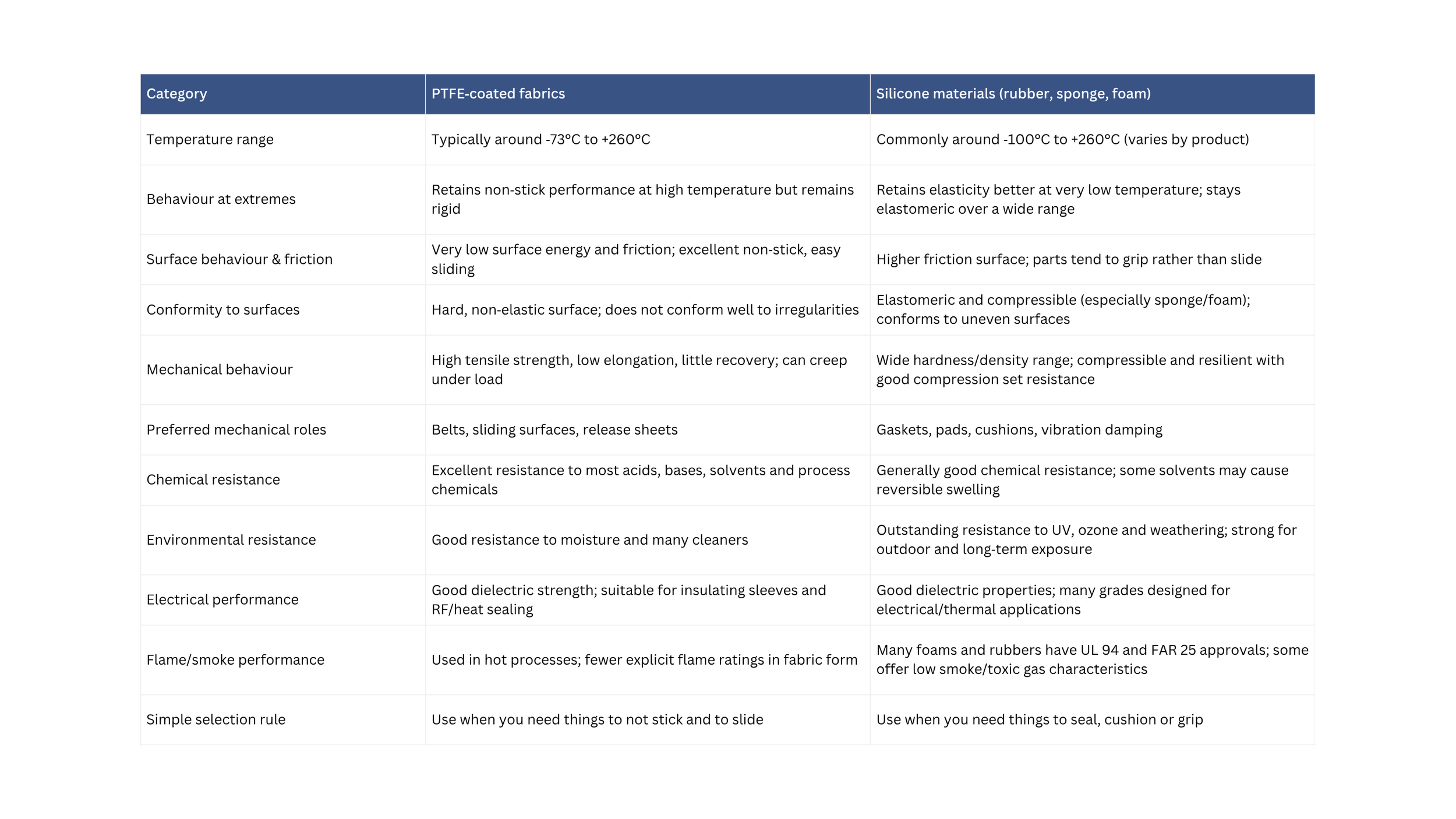
PTFE vs Silicone: How They Compare
As a rule of thumb, if you want things to not stick and to slide, start with PTFE; if you want things to seal, cushion or grip, start with silicone.
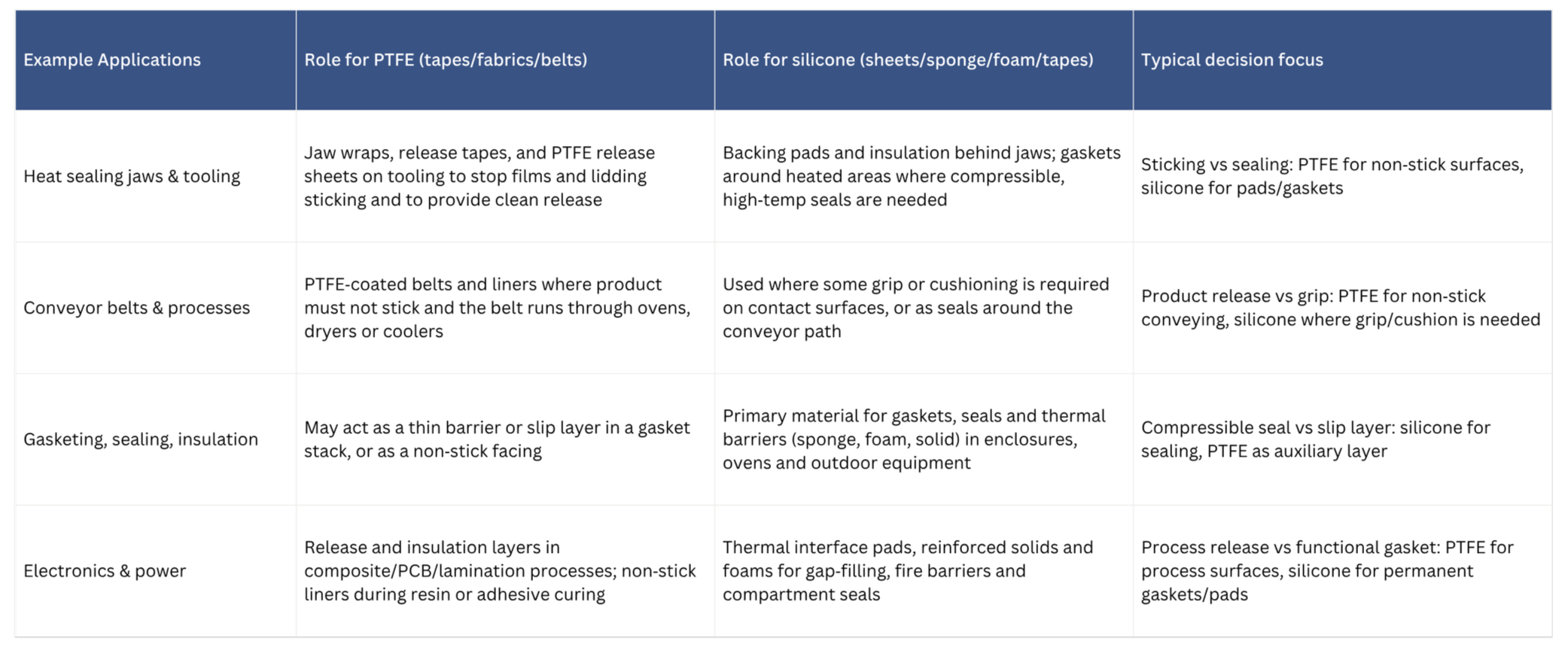
Application‑Driven Selection
If you are unsure whether PTFE or silicone is right for a particular application, the simplest next step is to contact us. We can:
Review the temperatures, media, compression requirements and mechanical loads in your process.
Recommend a PTFE coated fabric, belt or tape, or a silicone sheet, sponge or tape, based on real‑world New Zealand installations.
Arrange sample material or trial rolls, cut to your required width or profile.
To discuss your application and get a material recommendation, just contact us and we’ll talk through the details with you.