
Confidence in Temperature and Chemical Resistance: Selecting PTFE and Silicone Materials That Are Truly Fit for Process Conditions
A material described as “high temperature” or “chemical resistant” is not automatically right for your line.
For engineers, production managers and maintenance teams, the real question is more specific: Will this tape, fabric, belt or silicone rubber continue to perform at our operating temperature, under our pressure, through repeated cycles, and in contact with our actual process chemicals?
That confidence matters in heat sealing, curing, food processing, gasketing, insulation, composite moulding and industrial fabrication. A material failure can mean inconsistent seals, product contamination, line downtime, leaking gaskets, damaged equipment or an unplanned maintenance shutdown.
Brown International helps New Zealand manufacturers select PTFE tapes, coated fabrics, conveyor belts and silicone rubber solutions based on the complete operating environment - not a generic temperature claim. As the exclusive New Zealand distributor for Saint‑Gobain, Taconic and Versiv Composites, we combine established global materials with practical local technical support.
Temperature rating is only the starting point
A published temperature range is important, but it is not a complete specification.
A material may tolerate a certain maximum temperature in a controlled, low-stress environment, yet degrade more quickly in an application with pressure, high-speed movement, repeated heating and cooling, abrasion, steam, oils, cleaning chemicals or mechanical flexing.
For example, many PTFE-coated fibreglass fabrics and belts are rated for continuous service up to 260°C (500°F). Taconic states that its PTFE-coated fibreglass materials are designed for continuous operation up to 260°C, while its food-processing belt materials are listed from −73°C to 260°C.
Versiv CF410 PTFE-coated fibreglass is also specified for a temperature range of −150°C to 260°C. Its datasheet identifies the material as thermally stable, chemically inert, non-stick, washable and dimensionally stable.
But a temperature rating alone does not tell you:
Whether the material is exposed continuously or intermittently
Whether 260°C is the surrounding air temperature or a local surface hot spot
Whether heat is applied under pressure, such as at a heat-seal jaw
Whether the backing, adhesive, splice or gasket design has a lower limit
Whether repeated thermal cycling will affect the installation
Whether process chemicals, oils, moisture or steam are present
Whether the material must also provide release, insulation, flexibility or compression recovery
The right material decision starts with the application - not the headline temperature figure.
Why PTFE is widely used in high-temperature processes
PTFE is valued in industrial manufacturing because it combines low friction and non-stick release with heat resistance and chemical resistance. PTFE materials are commonly used in heat sealing, packaging, food processing, curing, composite moulding, electrical insulation, gasketing and release-sheet applications.
PTFE-coated fibreglass adds a woven glass reinforcement beneath the PTFE surface. The result is a material that can offer:
High-temperature performance
Low-friction, non-stick release
Resistance to many chemicals
Dimensional stability
Mechanical strength and tear resistance
Electrical insulation characteristics
Washability and hygienic performance for suitable applications
Versiv CF203, for example, is a smooth PTFE-coated fiberglass fabric used in belting, heat sealing, packaging, gasketing and release sheets. It is listed as chemically inert, non-stick, washable, food compliant, hygienic, fire resistant and capable of excellent heat transfer, with a temperature range from −240°F to 500°F (−151°C to 260°C).
That combination makes PTFE a strong starting point for difficult environments. However, PTFE is not one single performance level. Its suitability depends on grade, thickness, coating content, backing, adhesive, mechanical loading and the full process chemistry.
The material system matters: coating, fabric and adhesive
A tape or fabric should never be evaluated only by its visible PTFE surface.
For an adhesive-backed PTFE tape, the complete system can include:
A PTFE coating or PTFE film surface
Fibreglass reinforcement or another backing construction
A pressure-sensitive adhesive
A release liner, where applicable
Each layer can have a different performance role and limitation.
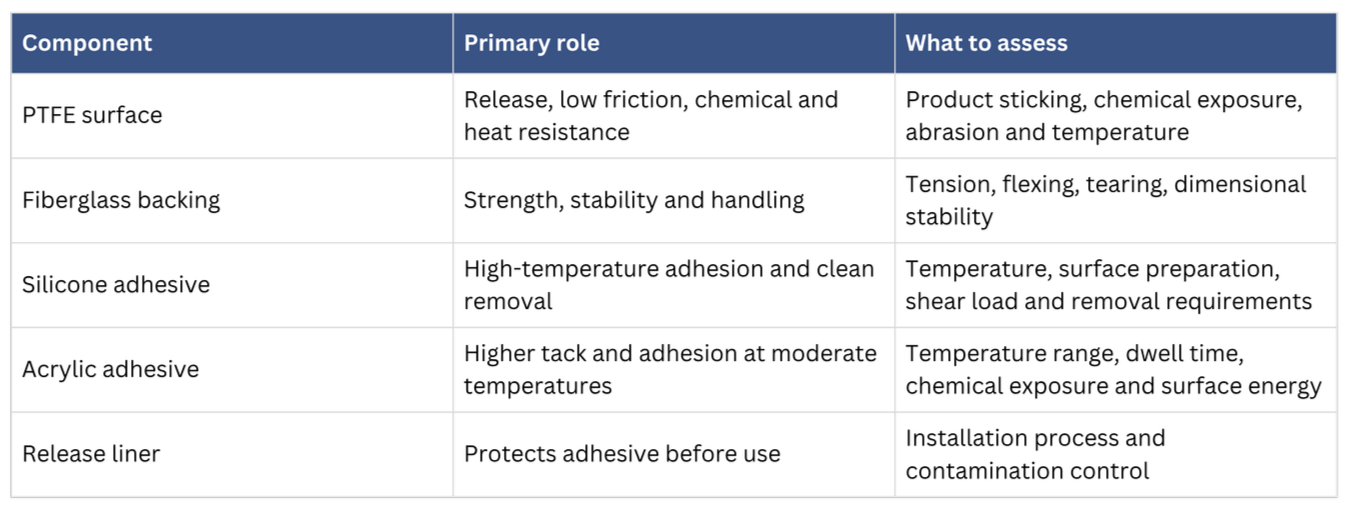
Taconic identifies silicone adhesive as a high-temperature, clean-removal system, while acrylic adhesive is typically used where moderate temperature performance, high tack and strong adhesion are required.
For example, a PTFE film tape with a silicone adhesive may be rated to 260°C, while a comparable acrylic-adhesive tape may have a lower operating-temperature limit. In Taconic food-processing reference data, a silicone-adhesive tape is listed from −73°C to 260°C, while an acrylic-adhesive PTFE tape is listed from −40°F to 350°F (approximately −40°C to 177°C).
This is why “PTFE tape” is not enough information for a high-temperature process. The adhesive must be included in the decision.
PTFE tapes for heat sealing: assess the whole duty cycle
Heat-sealing applications place demanding requirements on tape. A jaw cover needs to provide release and abrasion resistance while allowing enough heat transfer to form a consistent seal.
Saint‑Gobain heat-sealing tapes are designed to provide a non-stick, abrasion-resistant surface for high-temperature heat-sealing processes, including food and medical packaging applications.
But heat-sealing tape performance depends on more than the maximum set-point temperature. Maintenance teams should assess:
Seal-bar or impulse-wire temperature
Whether the machine runs continuously or intermittently
Dwell time and pressure
Film type, thickness and seal window
Line speed
Frequency of tape changes
Abrasion from film movement or product contact
Cleaning chemicals and cleaning frequency
Whether easy, residue-free tape removal is required
A tape that appears appropriate on a data sheet can still fail if it is too thin for the abrasion level, too thick for the required heat transfer, fitted over a damaged jaw, or supplied with an adhesive unsuited to the operating temperature.
A practical heat-sealing example
A packaging line operating near the upper end of a silicone-adhesive tape’s range may experience early failure if the jaw contains local hot spots above its nominal setting. The tape can blister, shrink, slide or lose adhesion - particularly if the jaw surface is contaminated or damaged.
The right response is not automatically “buy a thicker tape.” It may involve:
Confirming actual surface temperature rather than relying on the controller display
Checking for uneven heating or damaged jaw surfaces
Reviewing tape construction and adhesive system
Confirming width and installation technique
Considering a premium or higher-performance PTFE glass-cloth construction
Reviewing whether a zone-tape design is needed to keep adhesive away from the hottest area
Brown International can help identify a tape construction that balances release, heat transfer, adhesion and service life for the specific sealing process.
Chemical resistance: compatible does not mean invincible
PTFE is chemically inert and has excellent resistance to many acids, bases and solvents. That is one reason it is used in environments involving adhesives, oils, food ingredients, cleaning chemicals, coatings and industrial process fluids.
However, “chemical resistant” should not be interpreted as “safe with every chemical in every condition.”
Chemical compatibility depends on factors including:
The exact chemical or mixture
Concentration
Temperature
Exposure time
Whether the chemical is liquid, vapour, aerosol or residue
Pressure and mechanical stress
Repeated washdown or cleaning cycles
The backing, adhesive, splice, gasket or other non-PTFE component
PTFE may tolerate the chemical exposure well, while an adhesive, silicone rubber formulation, fabric edge, belt splice or substrate beneath it is less resistant. This distinction is crucial for heat-seal tapes, adhesive-backed liners, gaskets and fabricated belts.
Saint‑Gobain notes that PTFE tapes offer strong chemical resistance and are suited to applications with high chemical exposure. But manufacturers also state that users must verify material suitability and safety under their own intended service conditions.
Ask these questions before approving a material
Before specifying PTFE tape, coated fabric or silicone rubber for chemical exposure, document:
What chemicals are present, including cleaning and sanitising products?
What are their concentrations and temperatures?
Is exposure continuous, intermittent or accidental?
Is the material immersed, splashed, wiped or exposed to vapour?
Is the application pressurised?
Are there mechanical loads, tension or compression at the same time?
Are there any food-contact, medical, electrical or audit requirements?
What is the consequence if the material swells, hardens, loses adhesion or contaminates the product?
The more complete the information supplied, the more confidently an appropriate material can be selected.
PTFE coated fabrics: match grade to temperature, release and strength
PTFE-coated fabrics are offered in premium, standard, mechanical and economy grades because different processes need different levels of release, coating weight, durability and surface texture.
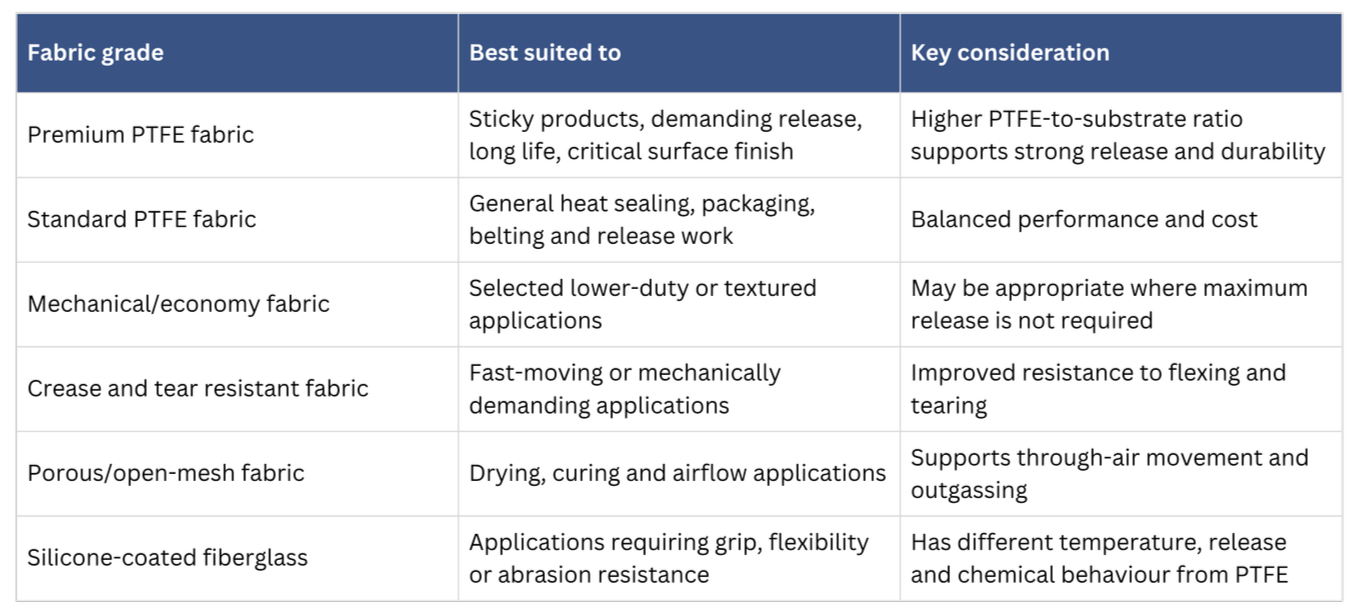
Taconic premium-grade PTFE fabrics are designed for applications where superior release, heat resistance, chemical resistance and durability are important. Standard grades provide a widely applicable balance of release performance, temperature resistance and value.
The correct grade is determined by the cost of failure. If poor release creates scrap, downtime or cleaning issues, a premium construction may provide a lower total cost of ownership. If the application is lower duty and does not require maximum surface performance, standard or economy material may be entirely appropriate.
Curing and drying lines: thermal stability is not enough
Curing, drying and bonding lines may expose coated fabrics and belts to sustained heat, airflow, tension and chemicals from coatings, resins, inks, adhesives or solvents.
For these applications, assess:
Continuous operating temperature and any peak temperatures
Exposure to hot air, infrared, contact heat or heated rollers
Whether airflow through the material is required
Product or coating chemistry
Tension, speed and roller diameter
Requirement for a smooth versus textured surface
Potential buildup and cleanability
Need for anti-static properties
Open-mesh or porous PTFE constructions are commonly selected where air movement and outgassing are important. Standard smooth fabrics may be more suitable for release sheets, heat sealing and product-contact surfaces where consistent surface finish matters.
A curing line can therefore require a different fabric construction from a heat-seal jaw or a static release liner—even if all three applications operate at similar temperatures.
Silicone rubber for gasketing and high-temperature sealing
Silicone rubber is commonly selected for gasketing, cushioning, sealing, insulation and high-temperature equipment because it combines thermal stability, flexibility and compression performance.
Saint‑Gobain Norseal 300–700 solid silicone rubber is available in hardness grades from 30 to 70 Shore A and is recommended for service from −73°C to 260°C. It is supplied in standard thicknesses from 0.79 mm to 6.35 mm and offers low compression set, low outgassing, good chemical and fluid resistance, release characteristics and long service life.4taconic
For gasket design, choosing the right hardness and thickness is as important as confirming the temperature range.
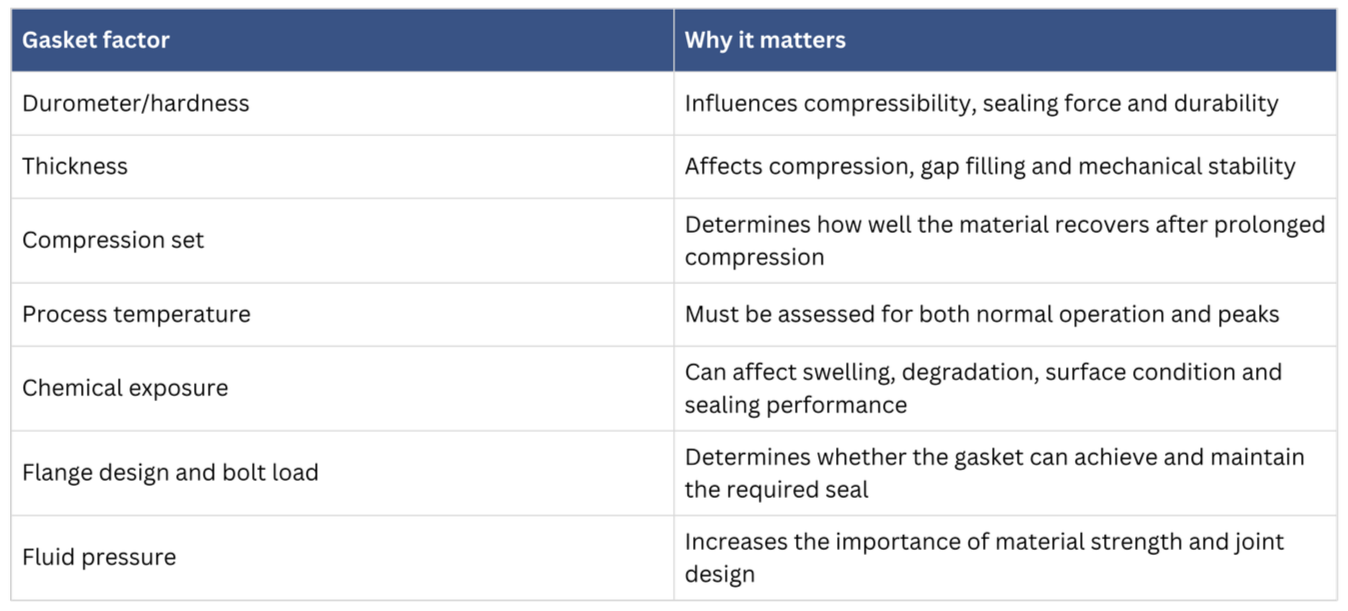
Norseal 300–700 grades are offered in 30, 40, 50, 60 and 70 Shore A hardnesses. Typical compression-set data at 70 hours and 302°F ranges from 15% for the 30–50 grades to 20% for the 60–70 grades.
Those values are useful for comparison, but they are not a substitute for application validation. A high-temperature gasket must be assessed in the full joint design, including clamp load, fluid pressure, thermal cycling and media compatibility.
PTFE vs silicone: do not assume they perform identically
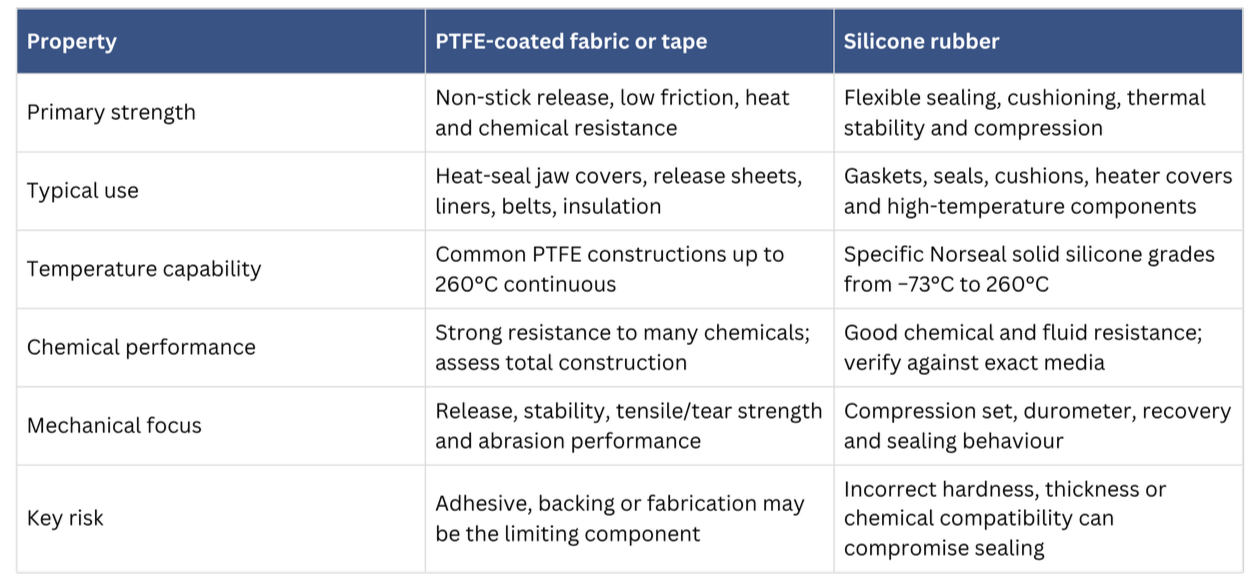
PTFE is often the better choice when release and low friction are paramount. Silicone is often preferable when a flexible, compressible seal or cushion is needed. In many pieces of equipment, both materials are used - PTFE tape on the non-stick sealing surface and silicone beneath it as a cushion or pressure pad.
Build confidence with a fit-for-purpose review
Before approving a material for a new application or replacing a repeatedly failing component, gather a complete set of operating details.
Information to provide to your supplier
Equipment type and application: sealing, curing, drying, gasketing, lining or conveying
Current material code, data sheet or photographs
Required dimensions, thickness and installation method
Normal operating temperature and peak temperature
Heating method: hot bar, impulse, oven, infrared, roller or direct contact
Duty cycle and expected service life
Product, process chemicals, cleaning agents and concentrations
Pressure, line speed, load, tension or compression requirements
Food-contact, electrical, medical or other compliance requirements
Description and photos of previous failures
This converts a general enquiry - “Do you have heat-resistant tape?” - into a proper material-selection conversation.
How Brown International supports reliable specification
Brown International supplies PTFE tapes, PTFE coated fabrics and belts, silicone rubber sheets and silicone SNS tapes to manufacturers across New Zealand. We work with maintenance, engineering and production teams to match products to actual machine conditions and avoid avoidable material failures.
Our support can include:
Reviewing temperature, process chemistry and mechanical conditions
Identifying whether PTFE, silicone or a combination is more appropriate
Comparing premium, standard and economy PTFE constructions
Selecting adhesive systems for high-temperature or high-tack requirements
Reviewing fabric thickness, belt strength, splice and edge options
Helping select silicone hardness and thickness for sealing or cushioning work
Providing relevant data sheets and product documentation
Supplying materials in practical formats through custom slitting and sizing
The result is greater confidence that the material has been selected for the job it needs to do—not just because it has a familiar name or a claimed temperature rating.
Frequently asked questions
Is PTFE suitable for continuous use at 260°C?
Many PTFE-coated fabrics, tapes and belts are specified for continuous service up to 260°C. However, the complete material system must be checked, including adhesive, backing, splice, edge treatment and the actual exposure conditions.
Is silicone rubber suitable for high-temperature gaskets?
Yes, selected silicone rubber grades are suitable for high-temperature gasketing. Saint‑Gobain Norseal 300–700 solid silicone is rated from −73°C to 260°C and is available in 30–70 Shore A hardnesses. Suitability still depends on joint design, compression, fluid pressure and chemical exposure.
Is PTFE resistant to acids, bases and solvents?
PTFE is widely valued for resistance to many acids, bases and solvents. However, compatibility must be assessed for the exact chemical, concentration, temperature, exposure duration and the entire product construction, including adhesive or backing materials.
Which adhesive is better for high-temperature PTFE tape?
Silicone adhesive is typically selected for high-temperature use and clean removal. Acrylic adhesive can offer high tack and strong adhesion but may have a lower service-temperature limit. The correct adhesive depends on the operating temperature, substrate, shear load and removal requirement.
Can Brown International help confirm chemical compatibility?
Brown International can help gather application information, identify suitable material options and obtain relevant technical documentation from our principals. Final suitability should be validated for the actual process conditions, particularly where chemicals, pressure, food contact or safety-critical performance are involved.
Specify with confidence
Temperature resistance and chemical resistance should be verified, not assumed.
If you are selecting PTFE tape for a heat-seal jaw, fabric for a curing line, a belt for a food process, or silicone rubber for a high-temperature gasket, Brown International can help you identify the relevant performance factors before a failure occurs.
Send us your current specification, operating temperature, chemicals, dimensions and a description of the application. We can recommend suitable PTFE or silicone options, provide data sheets and help you choose a practical format for installation.
Contact Brown International at sales@browninternational.co.nz or through our website to discuss a fit-for-purpose PTFE or silicone solution for your next maintenance, upgrade or production project.
