
Hidden Costs of Cheap Non‑Stick Solutions: Why the Lowest Unit Price Can Cost More
A low-cost PTFE tape, coated fabric or conveyor belt can look like a sensible procurement decision—especially when maintenance budgets are under pressure. But when that material wears early, sticks to product, slows heat transfer or requires repeated change-outs, the apparent saving can quickly disappear.
For packaging, food processing and industrial manufacturers, the right non-stick solution should be assessed on total operating cost: product quality, scrap, line uptime, labour, energy and replacement frequency—not simply the price per roll, metre or belt.
Brown International helps New Zealand manufacturers select PTFE tapes, coated fabrics, belts and silicone materials that are appropriate for the real demands of their line. The goal is not always the most expensive option. It is the right specification for the application, supported with the technical data, sizing and local advice needed to improve total lifecycle value.
The cheapest material is not always the lowest-cost option
A non-stick tape or fabric is often a small line item on a purchase order. That can make it easy to judge on price alone.
However, a PTFE jaw tape, release sheet or conveyor belt has a direct effect on how reliably the equipment runs. If it provides poor release, inconsistent heat transfer, inadequate abrasion resistance or insufficient mechanical strength, the consequences can spread across production:
Increased product sticking, marking or tearing
Higher scrap and rework
Inconsistent seals and customer-quality issues
More frequent tape, liner or belt replacements
Unplanned downtime and maintenance labour
Increased cleaning time between runs
Higher energy use where heat transfer becomes inefficient
Greater risk of a rushed substitute being fitted after a failure
PTFE materials are available in different constructions and grades because production conditions differ. A low-cost material can be the correct choice for a low-duty, temporary or non-critical application. The mistake is using it on a high-speed, high-temperature or high-wear line where a premium or standard construction is required.
What drives the performance difference?
Not all non-stick materials are built the same way. Performance depends on the combination of coating, reinforcement, adhesive, thickness and fabrication.
For PTFE glass-cloth tapes, the glass fabric provides dimensional stability, tear strength and abrasion resistance, while the PTFE coating provides the non-stick surface. Different grades use different PTFE coating weights, creating a trade-off between economy, release quality, durability and surface finish.
Taconic’s nomenclature reflects those grade differences:
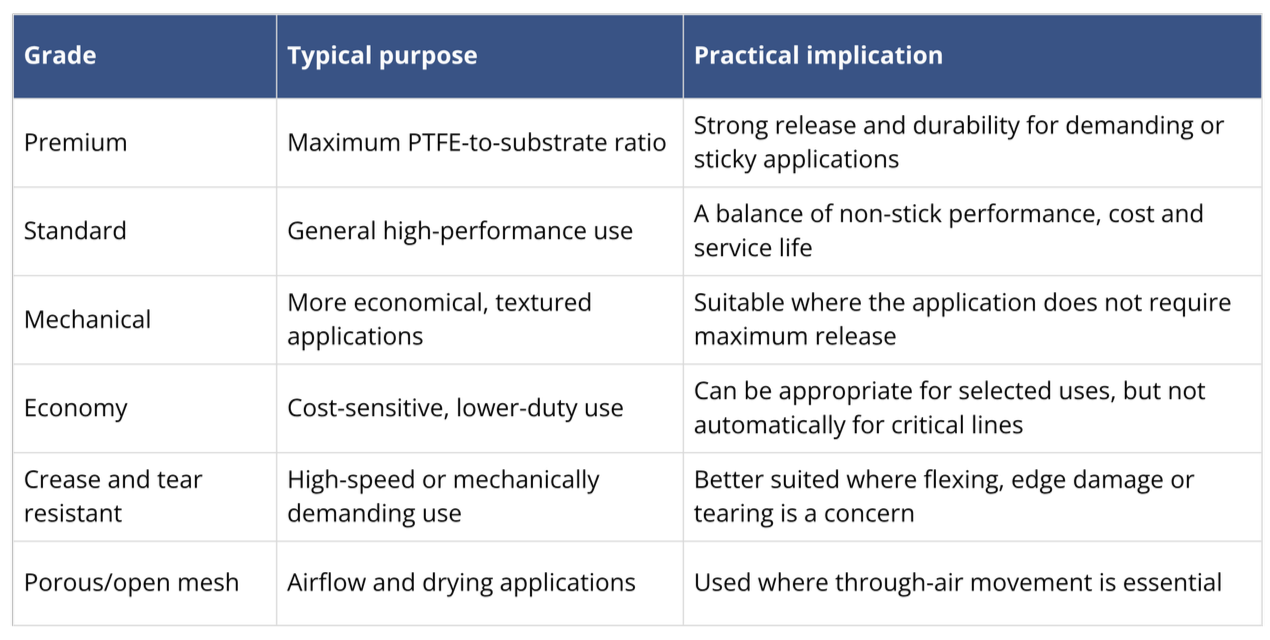
These classifications are not marketing labels. They describe differences in PTFE coating, construction and intended performance.
Hidden cost 1: Higher product scrap
Poor release is often the first visible sign that a non-stick surface is not suited to the process.
On packaging equipment, a worn or under-specified PTFE tape can allow film, adhesive or molten product to stick to a heat-seal jaw. The outcome may be inconsistent seals, wrinkling, contamination or damaged packs. In food processing, poor release can cause product to stick to belts, trays, liners or grill surfaces, affecting product appearance, yield and clean-down time.
High-quality PTFE heat-sealing tapes are designed to provide a non-stick, abrasion-resistant surface for high-temperature applications. Glass-cloth constructions improve tear strength, dimensional stability and abrasion resistance while maintaining a release surface.tapesolutions.
For food processing belts, improved release contributes to more consistent product movement, lower waste, reduced cleanup time and smoother continuous production.
Example: the cost of one poor sealing surface
Consider a packaging line using a tape that costs less per roll but wears quickly or loses its release performance. If operators need to stop the machine regularly to clean the jaws, adjust the tape or reject poor seals, the cost is no longer just the tape.
It may include:
Operator time during stoppages
Wasted packaging material
Lost product
Rework or repacking labour
Quality checks and batch holds
Lost production capacity
The direct material saving can be small compared with even a short period of lost production.
Hidden cost 2: More frequent change-outs
The lower-priced option may need replacing more often. That is particularly costly when a change-out requires a machine to stop, cool down, be cleaned and restarted.
PTFE heat-sealing tapes are available in different constructions to suit particular performance needs. Saint‑Gobain identifies options ranging from economic grades through to high-performance and premium solutions, with higher-performance constructions designed for better durability, cleaner release and longer service life in demanding heat-sealing applications.
In conveyor belting, durable PTFE-coated constructions are designed to reduce replacement frequency and downtime. Taconic notes that its food-contact grill belts are engineered for dependable release, consistent product movement, fewer belt changeovers, reduced waste and lower cleanup time.
The relevant comparison is not:
“Which roll costs less?”
It is:
“What does each option cost per productive hour, per production run or per million packs?”
Calculate cost per productive hour
A simple comparison is:

A premium material may have a higher purchase cost, but if it lasts significantly longer, reduces production interruptions and protects product quality, its cost per productive hour may be lower.
Hidden cost 3: Inconsistent heat transfer and slower production
Heat transfer is critical in heat sealing, laminating, cooking and drying applications. The tape or fabric sitting between the heat source and the product needs to balance protection and release with the thermal requirements of the process.
A material that is too thick, too heavily built or simply not appropriate for the process can reduce the efficiency of heat transfer. A material that is too light may transfer heat well initially but wear too quickly, tear, distort or lose release.
Saint‑Gobain’s heat-sealing guide highlights that thinner PTFE tape constructions can improve heat transfer and support faster line speeds in appropriate applications. It also identifies material grades that balance cost and life, alongside premium options designed for longer service in demanding processes.
The key point is that there is no universally “best” thickness. The correct selection depends on:
Seal-bar or hot-bar design
Film type and required seal temperature
Dwell time
Line speed
Pressure
Duty cycle
Required release performance
Abrasion and mechanical wear
Choosing solely by unit price can create a false economy if line speed is reduced, seal quality becomes inconsistent or operators compensate by changing machine settings.
Hidden cost 4: Excessive cleaning and contamination
Non-stick surfaces should make a process easier to clean. When the PTFE coating is too light, damaged or unsuitable for the product, residue can build up more quickly.
In food lines, that can mean sticky ingredients on belts and table liners. In packaging, it can mean film, adhesive or melted polymer accumulating on jaws. In either setting, operators spend more time cleaning and less time producing.
PTFE coated fabrics are used in food processing because they are non-stick, washable, food compliant, hygienic, dimensionally stable and capable of excellent heat transfer. Versiv’s standard CF203 PTFE coated fabric is designed to offer a smooth PTFE surface, with performance and durability at an affordable price, for applications including belting, heat sealing, packaging, gasketing and release sheets.
The word “affordable” matters. Good lifecycle performance does not always require the most premium grade. But it does require a material that has been properly matched to the temperature, product, operating conditions and intended service life.
Hidden cost 5: Premature belt wear and production disruption
A PTFE belt that is underspecified for its load, temperature, product stickiness or flexing requirement may show early wear at the surface, edges or splice. This creates risk of product sticking, tracking problems, edge fraying and unplanned replacement.
PTFE belts used for food processing may need to cope with high temperatures, oils, cleaning cycles, continuous flexing and product contact. Taconic food-processing constructions operate from −73°C to 260°C and are used for cooking or conveying products including steak, chicken, bacon, eggs, pizza crust and tortillas.
But temperature rating alone does not determine suitability. A belt also needs the right:
PTFE grade and coating weight
Thickness
Tensile and tear strength
Surface finish
Mesh or airflow requirement
Splice design
Edge reinforcement
Tracking system
For example, Taconic food-processing data includes a 0.009 in standard belt construction with typical tensile strength of 310/175 lb/in (warp/fill), while a 0.0135 in standard construction offers 500/300 lb/in and higher tear strength. Those are not interchangeable simply because both are PTFE-coated belts.
When an inexpensive belt fails early, the cost may include replacement material, emergency freight, lost production, labour, product scrap and the possibility of a rushed temporary repair.
The premium-versus-economy question
It is tempting to frame the decision as “premium is always better.” That is not the right conclusion.
The right decision is to match the material grade with the production risk.
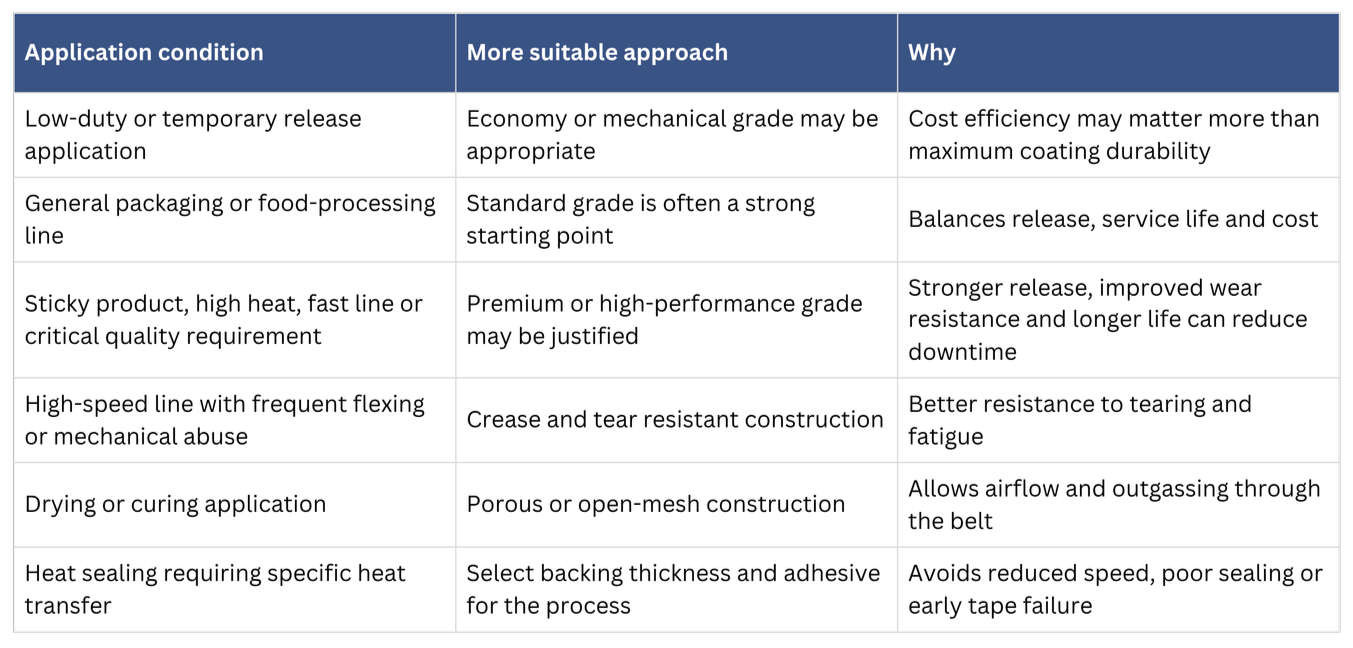
Taconic identifies premium PTFE-coated glass as having the highest PTFE-to-substrate ratio, standard grade as providing a smooth surface with excellent non-stick properties, and mechanical grade as an economical option.
The important question is not whether premium material costs more. It is whether a lower-cost construction exposes the line to unnecessary scrap, stoppages and labour.
Energy use: assess the process, not just the material
It is reasonable to ask whether a poor non-stick tape or fabric can increase energy use. The answer is that an unsuitable material may contribute to process inefficiency when it affects heat transfer, dwell time, cleaning frequency or line speed. However, the impact will vary by equipment design, operating settings and product.
A proper review should look at:
Does the material force higher temperature settings or longer dwell time?
Is heat transfer consistent across the working surface?
Has line speed reduced to maintain seal quality?
Are operators compensating for sticking with more frequent stops and re-heats?
Has buildup on the tape, fabric or belt created uneven processing?
Thinner PTFE tape constructions may improve heat transfer and permit faster line speeds in the right application, but that does not mean thinner is always better. The material must still provide enough durability, abrasion resistance and release performance for the duty cycle.
This is why a supplier should review the complete application rather than recommending a tape, fabric or belt based on unit price alone.
How to compare non-stick solutions properly
When comparing PTFE tapes, coated fabrics or belts, request information that goes beyond price.
For PTFE adhesive tapes
Ask for:
Backing type: PTFE glass cloth, PTFE film, high-modulus PTFE or other construction
PTFE grade or coating level
Overall thickness and backing thickness
Adhesive type: silicone, acrylic or another system
Continuous operating-temperature range
Peel adhesion and clean-removal requirements
Abrasion and tear resistance
Required tape width and roll length
Expected application life under your conditions
Saint‑Gobain’s heat-sealing portfolio includes tape options with silicone adhesive for high-temperature applications up to 260°C, while acrylic adhesive options are listed for lower-temperature sealing processes up to 177°C.
For PTFE coated fabrics and belts
Ask for:
PTFE grade and coating weight
Thickness and coated weight
Tensile and tear strength
Surface finish and release performance
Temperature range
Food-contact or compliance requirements, where applicable
Belt splice, edge reinforcement and tracking configuration
Cleaning regime and chemical exposure
Application-specific history or trial recommendation
A practical total-cost-of-ownership example
The figures below are illustrative only, but they demonstrate why purchase price should not be considered in isolation.
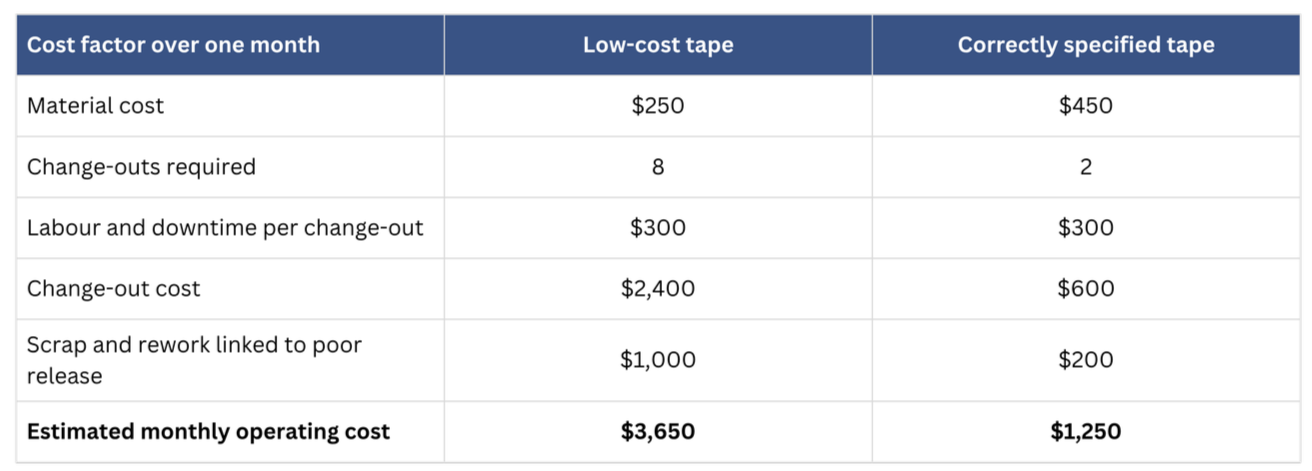
In this example, the lower-cost tape saves $200 in purchase price but creates an additional $2,400 in avoidable operating cost.
The numbers will differ on every line. The principle does not: low purchase price is not the same as low production cost.
How Brown International helps reduce hidden costs
Brown International supplies PTFE tapes, PTFE coated fabrics and belts, silicone rubber and silicone SNS tapes to New Zealand manufacturers. Our role is to help engineering, maintenance and production teams choose solutions that fit their machinery and process conditions—not just the lowest-priced option.
We can help with:
Reviewing the material currently fitted to your line
Identifying likely causes of poor release, early wear or inconsistent seals
Comparing premium, standard, mechanical and economy grades
Matching tape thickness and adhesive to heat-sealing conditions
Selecting belt construction, splice and edge reinforcement for food and industrial processes
Providing custom slitting and sizing to reduce installation time and waste
Supplying technical datasheets and product information for maintenance, QA and procurement teams
Because Brown International supplies approved materials from Saint‑Gobain, Taconic and Versiv, we can help you assess alternatives based on genuine technical differences - coating weight, temperature rating, strength, adhesive system and application fit.
Frequently asked questions
Are cheap PTFE tapes always poor quality?
No. An economical tape can be appropriate for a lower-duty or non-critical application. Problems arise when an economy-grade material is used in a high-temperature, high-speed, abrasive or sticky application that demands greater release, wear resistance or heat-transfer performance.
Does a thicker PTFE tape always last longer?
No. Thickness must be selected for the application. Thicker constructions may improve durability in some environments, but they can also affect heat transfer and flexibility. A thinner tape may be the better choice where high heat transfer and conformability are required.
How can we tell whether poor release is causing product scrap?
Track the relationship between material change-outs and quality rejects. Review where sticking, wrinkling, seal contamination, mark-off or product transfer occurs. Photos of the tape, fabric or belt before and after use - and notes on temperatures, line speed and cleaning - can help identify the cause.
Should we upgrade every line to premium PTFE material?
Not necessarily. Standard-grade material may be the most cost-effective choice for many applications. Premium products make most sense where release, uptime, heat, abrasion, cleanliness or product quality are critical.tapesolutions.
Can Brown International help compare an existing competitor product?
Yes. Provide the current material code or datasheet, dimensions, application, operating conditions and details of the problem. Brown International can help identify the relevant construction and recommend a suitable alternative.
Choose performance, not just price
The right non-stick solution should make your line more stable, not create more work for operators and maintenance teams.
If a PTFE tape, coated fabric or belt is generating frequent change-outs, poor release, seal inconsistency, excessive cleaning or product scrap, it is worth reviewing the full operating cost. A better-specified material may cost more per roll or metre—but deliver lower cost per production run.
Talk to Brown International about your current PTFE tape, coated fabric or belt. Send us the product code, dimensions, application, operating temperature, line speed and photos of the failure or product-quality issue.
We can help assess the right material grade, adhesive, thickness, belt construction or custom-slit format for a more reliable and cost-effective result.
Email sales@browninternational.co.nz or contact the Brown International technical team.
